Author name: wp_11817048

iStream Final Conference: exploring the future of immersive journalism education

On 19 June 2026, the University of the National Education Commission (UKEN) in Kraków hosted the iStream Final Conference, bringing together academics, educators, researchers, media professionals, technology experts, and members of the project partnership from all participating countries to discuss the future of immersive journalism and its role in higher education. The conference represented a major milestone for the iStream project and provided an opportunity to present its key achievements, share experiences, and reflect on how journalism education can evolve in response to technological innovation. Throughout the day, participants explored emerging trends in immersive journalism, the changing needs of the media industry, and innovative approaches to teaching and learning in this rapidly evolving field. The first session focused on the relationship between technological innovation and journalism education. Discussions addressed the evolution of immersive journalism, new opportunities and challenges for the media sector, and the competences required by future media professionals. Particular attention was devoted to the iStream Competence Framework, one of the project’s key results, which defines the knowledge, skills, and competences needed by immersive journalists working in increasingly digital and interactive media environments. The second session explored the educational dimension of immersive journalism and presented the main resources developed by the project. Participants learned about the iStream Curriculum, a one-year study programme designed for higher education institutions, the iStream Syllabus, which supports teachers in delivering immersive journalism courses, and the iStream Lab Guidelines, which provide practical recommendations for establishing and managing immersive journalism laboratories. The session also presented insights from the pilot testing phase and discussed the future challenges and opportunities facing universities interested in implementing immersive journalism programmes. A recurring theme throughout the conference was the importance of combining journalism, storytelling, technology, ethics, and user experience within a coherent educational framework. Participants discussed how immersive technologies such as virtual reality, augmented reality, and interactive media are opening new possibilities for storytelling while also requiring new pedagogical approaches and professional competences. While the conference represented the culmination of many project activities, the work of the partnership continues. Project partners are currently carrying out the pilot testing phase, during which the iStream educational resources are being tested by higher education teachers and students across the partner countries. The feedback collected through this process will contribute to the final refinement and validation of the project’s outputs, ensuring their relevance, usability, and effectiveness in real educational contexts. At the same time, partner organisations are preparing the final national dissemination events, which will take place in each partner country. These events will showcase the project’s results to educators, researchers, media professionals, policymakers, and other stakeholders, promoting the adoption of the iStream resources and supporting the creation of a sustainable European network around immersive journalism education. As the project moves towards its final stage, the conference highlighted the value of international cooperation in fostering innovation in journalism education and preparing future media professionals for an increasingly immersive and technology-driven media landscape.

iStream Final Conference: immersive journalism education for the future

On 19 June 2026, the University of the National Education Commission (UKEN) in Kraków will host the iStream Final Conference, bringing together academics, educators, media professionals, researchers, and technology experts to explore the future of immersive journalism education. The conference will showcase the main results of the iStream project and provide an opportunity to discuss how immersive technologies are transforming journalism, media production, and higher education. The event will open with a welcome address by representatives of UKEN and an introduction to the iStream project and its international partnership. Participants will then explore current trends, opportunities, and challenges related to immersive journalism and the future skills required by media professionals. The first session, Immersive Journalism – Trends, Competencies and Challenges for the Media Industry, will focus on technological innovation in media education, the evolution of immersive journalism, and the Competence Framework developed within the iStream project to define the skills needed by future immersive journalists. The second session, Education for Immersive Journalism – Study Programmes, Teaching Methods and Laboratories, will present the educational resources developed by the project, including the iStream Curriculum, Syllabus, Lab Guidelines, and the results of the pilot testing activities carried out with teachers and students. Discussions will also address the future challenges and opportunities facing Higher Education institutions interested in implementing immersive journalism programmes. The conference is particularly addressed to: The iStream Final Conference represents the culmination of the project’s work and a unique opportunity to discover its results, exchange experiences, and discuss the future of immersive journalism education in Europe. Venue: University of the National Education Commission (UKEN), Kraków, PolandDate: 19 June 2026Time: 10:00–16:30 The full conference programme is available here. We look forward to welcoming you to Kraków.

iStream Lab Guidelines: a practical resource for building and managing immersive journalism labs

The iStream Lab Guidelines are now available as one of the key results of the iStream Erasmus+ project. The document was developed under the leadership of Infinitivity Design Labs (France), the partner responsible for this project output, in collaboration with the entire iStream consortium. The guidelines provide higher education institutions with a practical framework for designing, equipping, managing, and sustaining immersive journalism laboratories. The document is a practical instrument to help universities translate immersive journalism from concept into implementation. It supports institutions in making informed decisions about infrastructure, technologies, competences, teaching approaches, safety procedures, and long-term sustainability. Who Should Use the iStream Lab Guidelines? The guidelines have been designed for a wide range of stakeholders involved in journalism education and immersive media: Because immersive journalism combines storytelling, technology, ethics, and audience experience, successful implementation requires collaboration among different professional profiles. The guidelines provide a common reference framework for all of them. What Is Inside the Document? The iStream Lab Guidelines offer a comprehensive overview of the elements required to establish and operate an immersive journalism laboratory. 1. Immersive Technologies The document presents an overview of the technologies that can support immersive journalism education and production. It introduces different categories of equipment and tools, helping institutions understand which solutions may be most appropriate according to their objectives, resources, and level of development. One of the strengths of the guidelines is their emphasis on scalability. Institutions can begin with a basic setup based on 360° video and WebXR and progressively evolve toward more advanced immersive environments. 2. Competences Required Successful implementation of immersive journalism requires more than technology alone. The guidelines identify the competences needed by educators, students, and technical staff, helping institutions understand the knowledge and skills required to effectively design, deliver, and support immersive learning experiences. 3. Health, Safety, Ethics and Compliance Immersive technologies introduce new challenges related to safety, wellbeing, privacy, and ethics. The guidelines therefore provide recommendations on health and safety procedures, risk management, ethical considerations, and responsible implementation practices.Immersive journalism raises important ethical, psychological, and safety considerations. 4. Hands-On Activities To support practical implementation, the document includes examples of activities and learning experiences that can be integrated into immersive journalism programmes. These examples demonstrate how students can move beyond theoretical learning and engage directly in the creation, testing, and evaluation of immersive content. 5. Maintenance and Sustainability The long-term success of an immersive journalism lab depends on effective management and sustainability planning. The guidelines therefore address operational aspects such as maintenance, consumables, infrastructure management, and ongoing resource requirements.A frequently overlooked aspect of lab creation is long-term sustainability. How Should the Guidelines Be Used? According to the guidelines, universities can use the document to move from broad ambitions—such as innovating journalism education—to concrete decisions regarding infrastructure, tools, workflows, and learning activities. The guidelines are particularly powerful when used together with the other iStream project outputs: Download the iStream Lab Guidelines The document is available in multiple languages to support adoption across the partner countries. Download the guidelines here: We invite educators, universities, curriculum developers, media professionals, and innovation stakeholders to explore the document and discover how immersive journalism can be effectively integrated into higher education programmes.

Registration Now Open for the iStream Conference 2026 in Kraków

Registration is now open for the iStream Conference, which will take place on June 19, 2026, in Kraków. The international academic conference will focus on the future of journalism and the impact of new technologies in the media sector. The event will provide a valuable opportunity for researchers, professionals, and media experts to exchange ideas, discuss emerging trends, and build international networking connections within the journalism and communication fields. Submission of presentation proposals is open until June 5, 2026. Applications should be submitted through the official form:https://forms.office.com/Pages/ResponsePage.aspx?id=akoPVi8YPkWiiyLhYKqrk1SQrdcSAiFPjrik79S3FANUQk1GT01OTUdSWVAwUUFIUEI3UUVQMUJMUi4u The detailed conference programme will be published on June 12, 2026, on the project website and will also be sent by email to participants who register through the submission form.

iStream Syllabi now available: A new framework for teaching Immersive Journalism

We are pleased to announce the publication of the iStream Syllabi, a key result of the iStream Erasmus+ project, designed to support the integration of immersive journalism into higher education programmes. The syllabi are now available in English and in the languages of the project partnership, ensuring accessibility and adaptability across different national and institutional contexts. A Core Result of the iStream Project The iStream Syllabi represent one of the main results of the project.They provide a comprehensive, structured, and ready-to-use educational framework for designing and delivering courses in immersive journalism. Developed through collaborative work among project partners, the syllabi translate research, pedagogical innovation, and industry needs into practical teaching tools. Who Are the iStream Syllabi For? The iStream Syllabi are designed for: They are flexible and scalable, allowing integration into Bachelor, Master, and specialised training programmes. Structure of the iStream Syllabi The iStream Syllabi are organised into a comprehensive programme structure that combines theory, practice, and applied research. Part 1 – Programme Overview This section introduces the Immersive Journalism Study Programme and its vision, covering key thematic areas such as immersive journalism foundations, media law, ethics, digital storytelling, immersive technologies, UX/UI, and research methods. Part 2 – Teaching and Learning Integration This section explains how the syllabi align with Bloom’s Revised Taxonomy and the European Qualifications Framework (EQF), and how they can be effectively implemented in teaching and learning contexts. Part 3 – Bachelor Syllabi This section includes a full set of modules designed for undergraduate programmes, such as: Part 4 – Master Syllabi This section presents advanced modules tailored for postgraduate education, building on the same structure with deeper technical, analytical, and research-oriented components. Why the iStream Syllabi Matter The iStream Syllabi respond to a growing need in higher education by bridging the gap between traditional journalism education and emerging immersive technologies. They enable institutions to: The iStream Syllabi are available in multiple languages to support accessibility and uptake across the partner countries. You can download the different versions below:

Scientific Conference Summarising the iStream Project – The Future of Immersive Journalism

On June 19, 2026, an international scientific conference presenting the results of the iStream project will take place at the University of the National Education Commission in Kraków. The project is implemented under the Erasmus+ programme (Cooperation Partnerships in Higher Education, KA220-HED). The iStream project focuses on the use of immersive technologies—such as VR and AR—in the media, journalism, and communication sectors. Its main objective is to reduce the skills gap by developing modern educational programmes and adapting higher education to the rapidly evolving needs of the media market. During the conference, key project outcomes will be presented, including: The conference will provide a platform for exchanging experiences between academia and media professionals, as well as an opportunity to discuss the future of communication in the context of immersive technologies. The event is particularly addressed to: Participation in the conference offers an excellent opportunity to explore the latest trends in media education and to establish international cooperation in the field of immersive journalism. The detailed conference programme will be announced soon.

iStream Transnational Course in Krakow

From 23 to 27 March 2026, partners of the iStream project gathered in Krakow, Poland, for an intensive training programme hosted by the University of the National Education Commission (UKEN). The mobility combined theoretical insights, hands-on experimentation, and collaborative reflection, focusing on the evolving intersection of artificial intelligence, immersive technologies, and media innovation. A Deep Dive into AI and Synthetic Media The training opened with a thought-provoking lecture on the “synthetic world,” exploring how deepfakes, chatbots, and generative AI are reshaping human interaction and media ecosystems. This session set the conceptual foundation for the week, encouraging participants to critically reflect on the ethical, social, and professional implications of AI-driven environments. Participants then engaged in practical sessions such as “The Persona Machine”, which introduced methods for designing and governing virtual media identities, and “Synthetic/Captured”, focusing on hybrid workflows for immersive environments. These sessions highlighted how AI and spatial computing are transforming storytelling and content creation. Hands-On Learning in Innovative Spaces A key strength of the training was its experiential dimension. Activities held at FabLab Małopolska enabled participants to explore digital fabrication and creative prototyping, bridging the gap between theory and application. The visit to the Wesoła Immersive – New Media Art Center further enriched the experience, offering insights into how immersive technologies are used in artistic and cultural contexts. This exposure demonstrated the potential of XR environments not only in education but also in creative industries and public engagement. Designing Immersive Learning Environments Another central focus of the programme was the design and implementation of immersive labs. Sessions explored what an effective immersive learning space should look like, combining technological infrastructure with pedagogical strategies. Participants also examined the integration of voice assistants in virtual reality and discussed how interactive systems can enhance engagement and user experience in immersive environments. Empathy, Engagement, and Future Skills One of the most impactful sessions addressed “immersive empathy at scale,” presenting research on how audiences perceive and emotionally engage with immersive content. This highlighted the importance of human-centred design in digital innovation. Throughout the week, collaborative project meetings complemented the training sessions, ensuring alignment among partners and supporting the co-development of future project outputs. Overall, the training represented a valuable opportunity to strengthen competencies in AI and immersive technologies, foster international collaboration, and explore innovative approaches to education and media. It demonstrated how interdisciplinary learning environments can support the development of future-ready skills in an increasingly digital and immersive world.

The Immersive Journalism Study Programme: shaping the future of media education

We are proud to present The Immersive Journalism Study Programme, a comprehensive one-year study track curriculum worth 60 ECTS credits, designed to prepare the next generation of media professionals for the immersive age of journalism. The programme can be implemented as a specialisation year for BA students, as a one-year MA programme, or as a postgraduate pathway. It consists of 15 courses, structured into a coherent and modular curriculum, and formalised in a document available in English and all partners’ languages, ensuring wide accessibility and transferability across Europe. The Immersive Journalism Study Programme introduces an innovative and interdisciplinary approach to media education, combining journalistic integrity with the creative and technological power of immersive storytelling. As journalism evolves towards interactive and experiential formats driven by virtual, augmented, and mixed reality, the curriculum equips students with the theoretical foundations, ethical awareness, and technical skills needed to shape the future of news and narrative communication. Blending academic research, hands-on training, and creative experimentation, the programme prepares graduates to produce compelling, socially responsible immersive stories that inform, engage, and inspire audiences. Students explore the intersections between journalism, technology, psychology, design, and ethics through a carefully structured learning path. The curriculum is organised into 15 modules: The Immersive Journalism Study Programme aims to educate innovative, critical, and ethically grounded media professionals capable of redefining journalism beyond screens and engaging audiences through immersive experiences. The full Immersive Journalism Study Programme Curriculum is available for download in English and in the languages of all project partners, supporting adoption by higher education institutions across Europe. 🇬🇧 English – Download🇮🇹 Italiano – Download🇵🇱 Polski – Download🇫🇷 Français – Download🇬🇷 Ελληνικά – Download For further updates, tools, and upcoming publications, please follow us on our Facebook Page and LinkedIn Page.

The iStream Competence Framework is now available!

We are pleased to announce that the English version of the iStream Competence Framework is now officially available on the project website. This publication represents an important milestone in the development of a professional profile for the immersive journalist. The framework outlines the key competences needed to operate in this emerging field, combining technical, creative, ethical, and social dimensions. It is structured to support both individual learning and institutional training design. Developed in line with recognised European standards, the framework is intended for: The English version aims to make the content accessible to a broad international audience. Translations in all partner languages will follow shortly, allowing local adaptation and broader dissemination. The framework can be accessed and downloaded directly from the project website (here). For further updates, tools, and upcoming publications, please follow us on our Facebook Page and LinkedIn Page.

iStream – Second Transnational Project Meeting

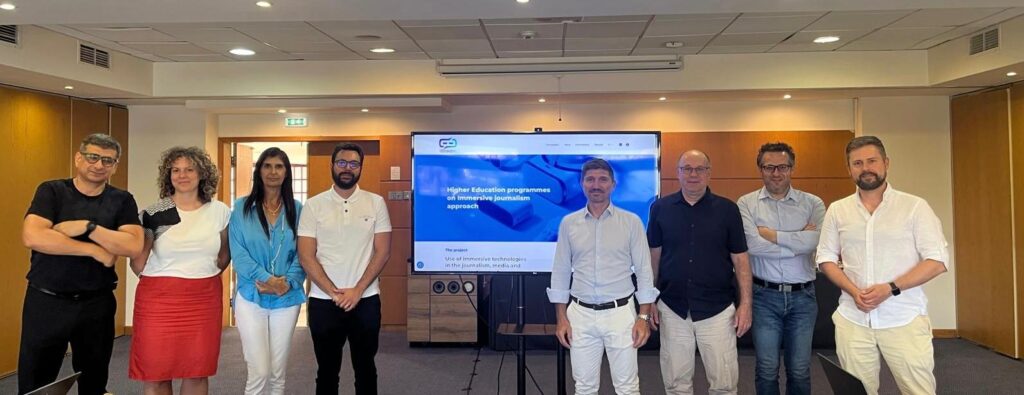
The second transnational project meeting of iStream took place on June 16 and 17, 2025, at the Golden Bay Beach Hotel in Larnaca, Cyprus. The iStream project aims to bridge the gap of competences in the use of immersive technologies within the media, journalism, and communication sectors. The meeting was hosted by the University of Nicosia (UNIC) and gathered all partner institutions: During the meeting, the partners reviewed the progress made so far and aligned on the next phases of the project. The main topics discussed included: Key points of the meeting: The meeting also included planning moments for the next key project events: To stay updated on project developments, you can visit the Facebook Page and LinkedIn page.

Scroll to Top